


Discover the Charm of Walterboro, SC: A Journey Through a Quintessential Southern Town
- CHSMLS

- Dec 30, 2025
- 4 min read
Walterboro is a historic town located nearly equidistant between Charleston and Beaufort in the South Carolina Lowcountry. With just over 5,400 residents, Walterboro feels sleepy and safe, boasting a quaint downtown, a range of price-point options for housing, and a perfect blend of town and country. Let's discover Walterboro SC, "the front porch of the lowcountry."

Foundations
Walterboro was established shortly after the American Revolution by rice planters in the ACE Basin area (Ashepoo, Edisto, and Combahee Rivers) who sought to create a summer village closer to Charleston, where they could escape the swamps and the threat of yellow fever. It is named after early settlers Paul and Jacob Walter; Paul’s young daughter, Mary, had been stricken with malaria, and he set out to create a community further from his plantation swamplands for her health. By the 1820s, Walterboro was thriving and had become the Colleton District seat, replete with a Robert Mills courthouse. Walterboro was incorporated in 1826 and had a library, a tavern, and several stores by that time. Mills’ Atlas shows Walterboro tucked between small rural roads heading to Charleston amid a plantation landscape.


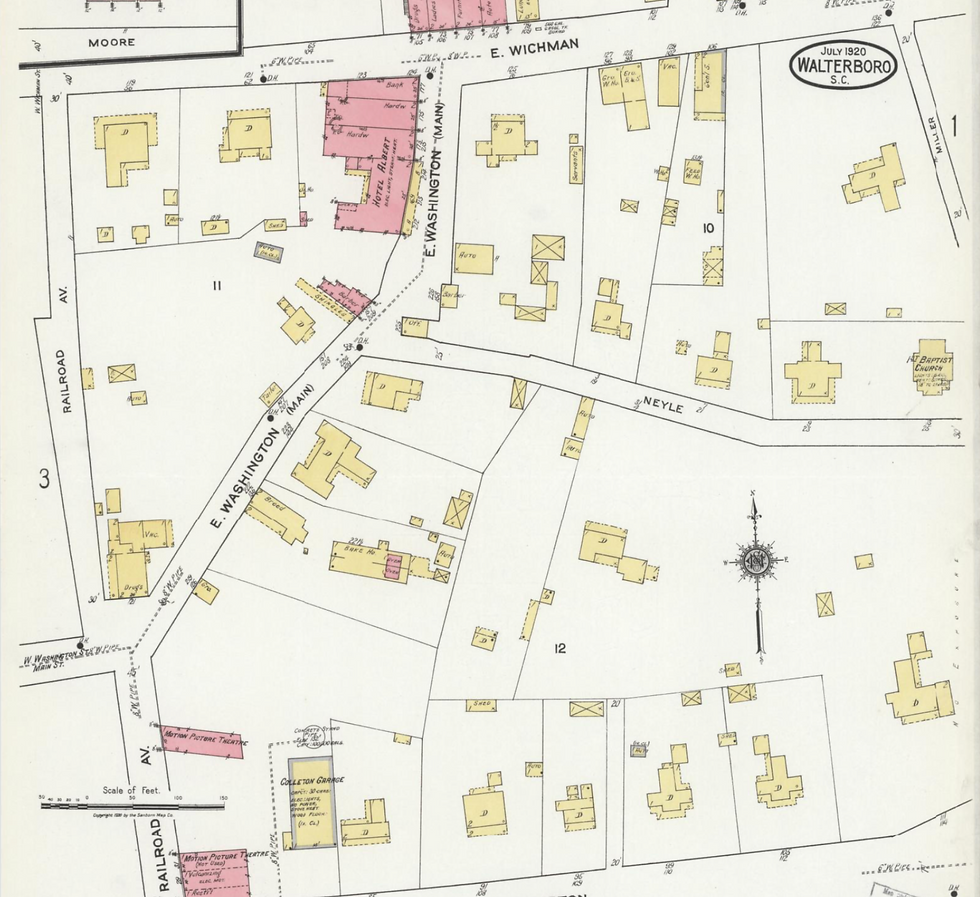
With the development of steam rail transportation after the 1830s, communities like Walterboro in St. Bartholomew's Parish, Adams Run in nearby St. Paul’s Parish, and Edingsville Beach in St. Johns Colleton continued to grow. Walterboro was “a hotbed of states’ rights sentiment in the antebellum years when the North and the South dueled over tariffs, western expansion, and slavery. In 1828, Robert Barnwell Rhett launched the nullification movement at the Walterboro Courthouse.” Residents fought for the Confederacy, and Walterboro declined politically and economically after the American Civil War as most white residents left with emancipation. A new Atlantic Coast Line Railroad spur brought growth again in the 1880s. In the 1910s and 1920s, Walterboro gained electric lights and paving for its two main streets. In 1942, the Walterboro Army Airfield opened, where young soldiers trained for air combat and to serve with fighter and bomber squadrons. Over 500 members of the famous black Tuskegee Airmen trained at Walterboro between 1944 and 1945.
Laylon Jordan explains that, “In the latter decades of the twentieth century, Walterboro added population and wealth as it developed jobs in construction and light industry as well as public services, such as the $28 million Department of Veteran’s Affairs Nursing Home. The high school was integrated and established itself as a football power in the 1970s, just as Colleton County was traversed by a new federal highway, Interstate 95. But if the old town was fading, links to the past survived. The farmers’ market was still a central institution. Townspeople held fast to traditional ties of family and church. Hunting was a favored pastime.”

Discover Walterboro, SC, Today
Walterboro’s historic downtown has grand houses dating back to the 1820s (such as the Bedon-Lucas house museum) and beautiful, elegant Victorian houses from the turn of the century. It is known as an antiquing and arts district, and fun weekend activities include the Tuskegee Airmen Memorial, South Carolina Artisans Center, Library, and County Museum in town. Walterboro has a vibrant farmer’s market on weekends, as well. The Walterboro Wildlife Center and Colleton State Park are great places to experience the great outdoors. The Walterboro Wildlife Sanctuary has over 800 acres of creek and hardwood flats traversable by boardwalks, bridges, and cycling/walking trails to view the inland swamps, cypress trees with Spanish moss canopies, a beaver pond, duck pond, and butterfly garden- all with free admission!


Walterboro is big enough to have chain and big box stores conveniently nearby, like Belk, Walmart, Harbor Freight, and Advance Auto Parts (and Dunkin’ Donuts, Starbucks, and Cracker Barrel in the restaurant variety), alongside local staples. Fat Jack’s has been serving steaks and seafood with no frills and great taste since 1999. Barrell House specializes in tasty pub food while Olde House Café focuses on mom-and-pop type meat and three cuisines. Bucky’s Seafood and Southern brings the soul food, and Dukes BBQ brings the ever-popular staple, pulled pork. Open since 1949, Dairyland remains an institution best known for great burgers, shakes, and ice cream.


The town also has a variety of parks: Forest Hills Tennis Center, Gladys Whiddon Park (with a lake for duck feeding), Pinckney Park (downtown, with picnic tables and places to relax), and Shaniyah Burden Memorial Park and playground.
Where to Reside
Walterboro has experienced a spate of growth and development in the last two decades and now has several well-planned subdivisions as well as custom houses and modular homes on large rural lots, and historic houses closer to town. Subdivisions include Sweetbriar I and II, Country Estates, Backfield, Long Leaf, Forest Hills, and Sandy Springs (whose names reference plantations and landscape features).
Follow along for more updates and resources!
For more real estate resources, follow CHS Regional MLS on Facebook and Instagram! If you’re not a member yet, join CHS Regional MLS for access to the Lowcountry's most extensive and accurate property database.
Sources:
Laylon Wayne Jordan. “Walterboro.” South Carolina Encyclopedia
Glover, Beulah. Narratives of Colleton County. N.p., 1963.
Elizabeth Stringfellow. A Place Called St. John’s. Spartanburg, S.C.: Reprint Company, 1998.
Realtor.com listings for Walterboro
https://www.carolinaone.com/walterboro-south-carolina-subdivisions.html


